
The images in this article are illustrative. This story is based on DogTime (November 4, 2026) and a video shared by @helpingforgottenpaws.
A Dog Nobody Asked to Meet
Titus is four years old. He is a pit bull with a gentle face and, by all accounts, a gentle nature to match. And for 713 days — nearly two full years — he lived in a kennel at Independence Animal Services in Independence, Missouri, waiting for someone to choose him.
Staff at the shelter put it plainly: Titus was a dog “nobody asks to meet.” Day after day, visitors walked past his kennel. Other dogs went home. Titus stayed.
Seven hundred and thirteen days is a long time to live in a kennel. It is roughly 1,700 meals eaten behind bars, hundreds of nights spent on a concrete floor instead of a couch, and more mornings waking up in the same small space than any dog should ever have to count. And he kept waiting.

The Day Everything Changed
Then, finally, it happened. After 713 days, Titus was adopted. He walked out of the shelter and into a real home, with real people and a real life outside the kennel walls.
For the first time in almost two years, he had a couch to sleep on instead of a kennel floor — a family, a home.
The shelter’s notes from his time in that home paint a picture of a dog who was easy to love. He was housebroken. He was easygoing. He lived happily with children under five. Staff described him as a couch potato — the kind of dog who is happiest doing absolutely nothing, as long as he is doing it next to you.
The long wait was over.

Six Months Later, the Door Closed Again
Six months after his adoption, Titus was back.
His family had lost their home, and with it, Titus lost his. There was no room for him anymore, no place for a four-year-old pit bull to go — except the one place he had finally escaped: the same shelter, the same kennels, the same walls.
He came back 30 pounds heavier than when he left. Shelter staff are now helping him work toward a healthier weight.
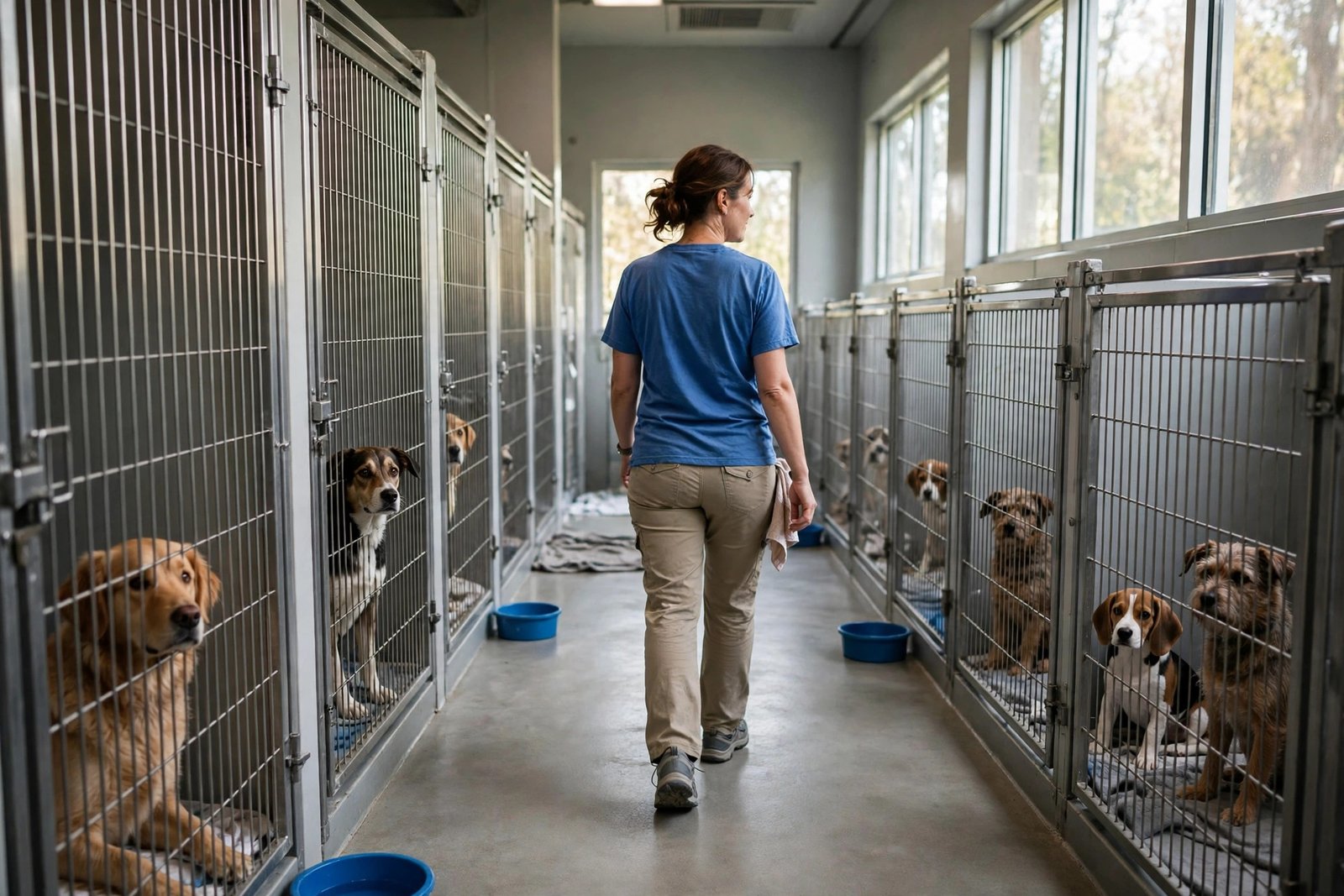
But the weight is not the hardest part to watch. Back in the kennel, Titus spends much of his time pacing. He licks the kennel walls. He looks, in the shelter’s own words, deeply unsettled — a dog who knows what home feels like and cannot understand why it is gone.
Why the Kennel Hits Some Dogs So Hard
There is a reason shelter workers worry most about the dogs who have been there longest. A kennel is loud, bright, and strange. The barking never really stops. The smells change every day as new dogs arrive. For a dog who has lived there for months or years, the stress builds quietly — and it shows in the small things: the pacing, the licking, the way a dog stops making eye contact or stops eating with enthusiasm.
Titus had already survived 713 days of that. Then he learned what a home felt like — a couch, children, quiet evenings, a family of his own. Losing that a second time is a different kind of heartbreak, and the pacing and wall-licking are how it looks from the outside.
None of this makes Titus a difficult dog — just a dog who has had bad luck — twice.
Why Returns Like This Happen
When a family loses its home, pets are often among the first casualties. A move into temporary housing, a relative’s spare room, or a rental with a strict no-pets rule can leave even the most devoted owner with nowhere to take their dog. It is not always a failure of love. Often, it is a failure of options.
That is why stories like Titus’s matter beyond a single dog. Every returned dog is a reminder that adoption is not just about the day a dog goes home — it is about everything that has to hold together afterward. Housing, money, health, life itself. When any of those give way, the dog is the one who pays.
It is also why shelters keep trying, even for the dogs who wait longest. A dog who has waited 713 days and been returned once is not a lost cause. He is a dog who has already proven he can be a wonderful family pet — he did it for six months, in a real home, with real children.
What Fifty Dollars Can Do
Titus is still waiting at Independence Animal Services in Independence, Missouri. His adoption fee is $50, with a discount for residents who have waited over 90 days.
Fifty dollars. That is less than a family spends on a single trip to the grocery store. And for Titus, it is the price of a second chance — a couch, a quiet house, a family that will not give up on him.
Long-stay dogs like Titus are often the best-kept secret in any shelter. They are past the wild puppy stage. Their personalities are known, not guessed. Staff can tell you exactly how they behave in a home, because they have already lived in one. Titus’s file reads like a wish list: housebroken, easygoing, gentle with small children, happy to spend the evening asleep on the couch.
The Wait Is Not Over Yet
Titus waited 713 days once. He found a home, lost it through no fault of his own, and now he is waiting again — pacing his kennel, licking the walls, wondering where home went.
But his story is not finished. Somewhere out there is a family with a couch, a little patience, and $50 to spare. Somewhere is a person who will walk past the puppies, past the brand-new arrivals, and stop at the kennel of the four-year-old pit bull who has waited longer than almost any dog in the building.
If that person is you — or someone you know — Titus is waiting at Independence Animal Services in Independence, Missouri.
And if you cannot adopt, you can still help. Share his story. Tell a friend. A single share costs nothing, and for a dog like Titus, it might be the one that finally brings him home — this time, for good.
Images in this article are illustrative and do not show Titus himself. Story based on DogTime, November 4, 2026, and a video shared by @helpingforgottenpaws.