The first time it happened, nobody paid attention.
It was 2:17 in the morning at Willow Creek Animal Shelter, and the building was almost completely silent. The daytime volunteers had gone home hours earlier. The kennels were dark. The only sounds were the hum of the old ceiling fans and the occasional movement of a sleeping dog.
Then Bruno woke up.
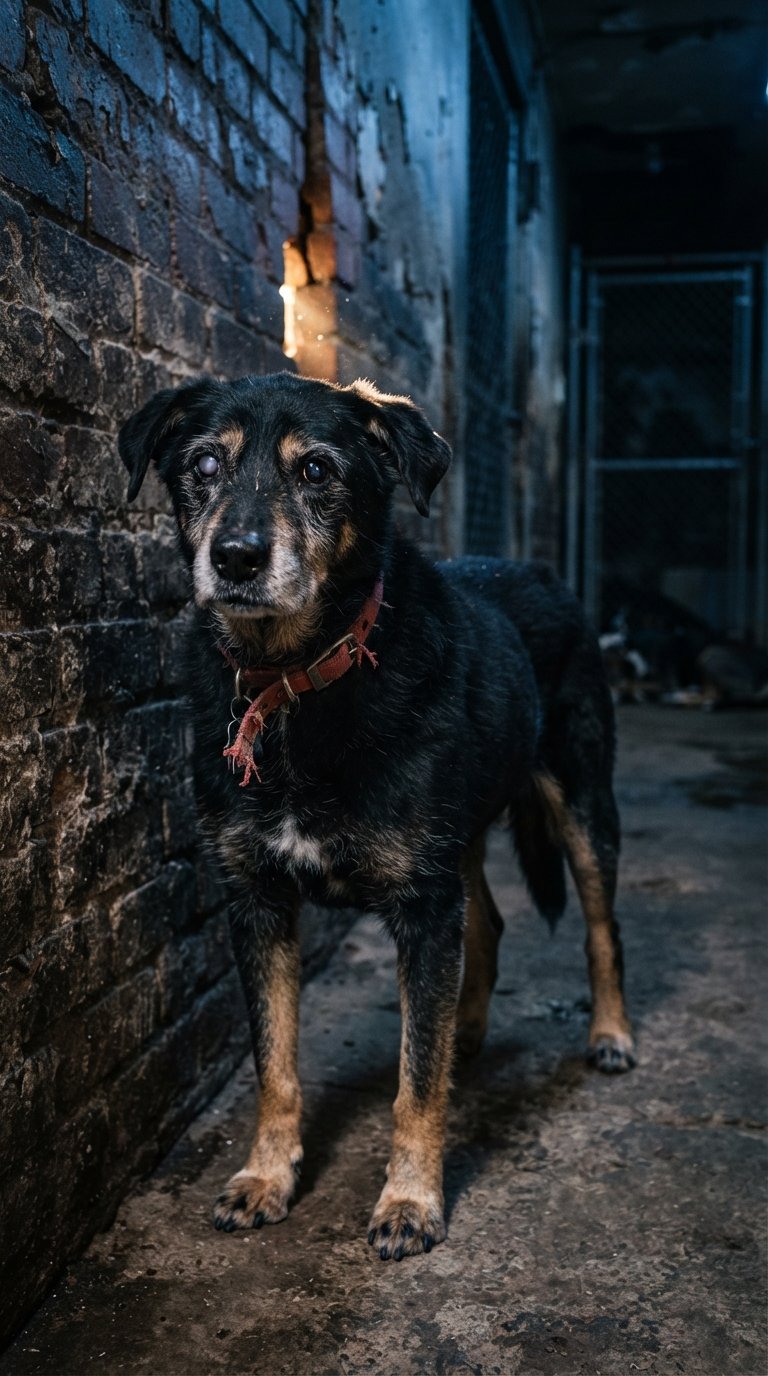
He was an old black-and-tan mixed-breed dog with a cloudy left eye, a white patch on his chest and a red collar that had faded almost pink with age. He had been living at the shelter for eleven months.
No one knew exactly how old he was.
The shelter records said “approximately nine,” but his tired eyes made him look older. He rarely barked.
He did not jump at the kennel door when visitors passed. He simply watched people walk by, as if he had already learned not to expect anyone to stop.
But that night, Bruno stood up suddenly.
He walked to the back of his kennel and stared at the brick wall.
For several seconds, he did nothing.
Then he lifted one paw and scratched.
Once.
Twice.
Then again.
The sound echoed through the dark corridor.
The night worker, Elena, looked up from her desk. She had been sorting medicine labels and almost ignored it. Shelter dogs scratched floors, doors and walls all the time. Fear, boredom and stress could make animals behave strangely.
“Bruno, go back to sleep,” she whispered.
Bruno did not listen.
He kept scratching the same spot.
Elena walked toward his kennel and shone her flashlight through the bars. Bruno turned his head toward her, but he did not stop. His eyes were fixed on the wall.
There was something different in his expression.
It was not excitement.
It was urgency.
Elena opened the kennel door and crouched beside him. Bruno immediately walked to the wall and pressed his nose against a narrow line between two bricks.
Then he made a soft sound.
Not a bark.
Not a growl.
A trembling whine.
Elena placed her hand against the brick. It felt cold.
She checked the time.
2:17 AM.
The next night, Bruno did it again.
At exactly 2:17.
The night after that, he did it again.
By the fourth night, Elena had started to feel uneasy.
She asked the shelter manager if there had ever been a problem with that wall. The manager said no. The building was old, but the wall had been inspected several times. There were no pipes behind it, no electrical lines and no known empty space.
“Maybe he hears mice,” the manager suggested.
But Elena was not convinced.
Mice did not explain why Bruno only scratched at 2:17.
On the sixth night, rain began falling heavily outside. Thunder rolled across the town, and several dogs started barking nervously.
Bruno ignored the storm.
At 2:17, he stood up again.
This time, he did not scratch immediately.
He looked at Elena.
Then he looked at the wall.
Then back at Elena.
It was as if he was waiting for her to understand.
“Okay,” she whispered. “Show me.”
Bruno scratched the wall so hard that one of his nails began to bleed.
Elena grabbed a flashlight and called the manager. Together, they examined the bricks. Near the floor, hidden behind a metal storage shelf, was a thin crack.
The manager moved the shelf aside.
Elena leaned closer.
At first, she heard nothing.
Then the sound came again.
A tiny, weak cry.
A kitten.
The manager froze.
They searched the outside of the building but found no opening. Finally, they called the fire department, and a maintenance worker carefully removed three loose bricks.
Behind the wall was a narrow cavity.
Inside it lay a small gray kitten, covered in dust and barely moving.
It had somehow crawled into the space through a broken opening on the other side of the building. Then the opening had collapsed, trapping it behind the bricks.
The kitten had been there for days.
No human had heard it.
No camera had seen it.
But Bruno had.
The worker reached inside and gently pulled the kitten free. Elena wrapped it in a warm towel while Bruno stood beside her, trembling.
The kitten was weak, hungry and dehydrated, but alive.
They named her Hope.
For the first few days, Hope remained in a small recovery box near the front desk. Bruno never left the area. Whenever Hope cried, he lifted his head. Whenever she slept, he rested his chin near the box.
The shelter staff began noticing something strange.
Bruno, who had ignored every visitor for almost a year, started approaching people.
He would sit beside Hope’s box and look up at anyone who came near.
It was as if he wanted them to see her.
Or perhaps he wanted them to see him too.
A week later, a woman named Claire visited the shelter. She had come looking for a kitten, but when she saw Bruno sitting beside Hope, she stopped.
“What happened to that old dog?” she asked.
Elena told her the story.
Claire listened quietly. Then she crouched beside Bruno.
For the first time in months, Bruno placed his head in someone’s lap.
Claire adopted Hope that afternoon.
And before she left, she filled out another form.
She adopted Bruno too.
The shelter workers cried when they watched them leave together.
Bruno had spent eleven months waiting for someone to notice him.
In the end, he saved a life—and the life he saved helped someone finally see his.
That night, the hallway at Willow Creek Animal Shelter was quiet.
There was no scratching at 2:17.
Because Bruno was no longer behind a kennel door.
He was asleep in a real home, beside the kitten he had refused to abandon.
And for the first time in a very long time, neither of them had to be afraid of the dark.