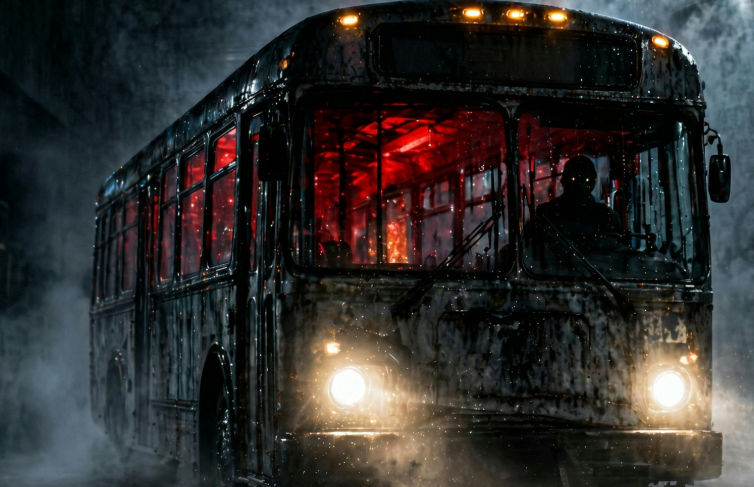
Marcus Hill had been driving overnight buses across Texas for eleven years. He preferred the night shift because the roads were quieter, the traffic was lighter, and most passengers slept through the journey.
He had seen strange things on the highway, but nothing had ever frightened him.
Until a rainy Thursday night in October.
The bus left Dallas at 11:40 p.m. with only twelve passengers. Marcus checked the passenger list before departure. Every name matched a ticket, and every passenger had an assigned seat.
The journey was ordinary until the bus reached a small stop outside a town called Red Creek.
No one was waiting at the shelter.
Marcus checked the mirror and began pulling away.
Then he saw a woman standing beside the road.
She wore a long brown coat and held a small black handbag. Her hair was wet, and her face looked unusually pale.
Marcus stopped.
The woman climbed aboard without saying a word.
“Ticket?” he asked.
She didn’t answer. Instead, she walked slowly down the aisle and sat in seat 19.
Marcus glanced at the passenger scanner. The screen showed twelve passengers.
He assumed the system had missed her ticket.
A few minutes later, he checked again.
Still twelve.
He tapped the scanner and selected the seat information.
**SEAT 19 — EMPTY.**
Marcus looked toward the back.
The woman was sitting perfectly still.
He stood up and walked down the aisle.
“Ma’am, I need to see your ticket.”
She slowly turned her head.
Her eyes looked strangely dark.
“I already gave it to you,” she whispered.
Marcus stepped back.
He returned to his seat and called the dispatch office. The dispatcher checked the route records and confirmed that no passenger had boarded at Red Creek.
Marcus asked whether the bus had stopped there the previous night.
There was a pause.
Then the dispatcher said, “Marcus, you don’t stop at Red Creek anymore.”
“What do you mean?”
“That stop was removed from your route twenty-two years ago.”
Marcus felt his hands go cold.
He looked into the mirror.
Seat 19 was empty.
For several minutes, he tried to convince himself that exhaustion had caused him to imagine the woman.
Then he heard a voice directly behind him.
“You finally came back.”
Marcus slammed the brakes.
The bus stopped on the wet highway. Passengers woke up, shouting in confusion.
The woman was standing in the aisle.
Marcus recognized her now.
He had seen her face before.
A faded newspaper clipping hung in the bus depot office. It showed a photograph of a woman who had disappeared during an overnight bus journey twenty-two years earlier.
Her name was Laura Bennett.
She had been the last passenger to board at Red Creek.
Marcus had been a trainee driver on that route at the time. He remembered the night vaguely: heavy rain, a roadside stop, and a woman who never reached her destination.
But the official report had said she never boarded.
Laura took one slow step toward him.
“Why did you leave me there?” she asked.
Marcus couldn’t speak.
The bus lights flickered.
Every passenger turned toward seat 19.
For one brief second, all twelve passengers appeared to be staring at an empty seat.
Then the lights returned.
The woman was gone.
Marcus drove directly to the nearest station and reported what happened. He quit the overnight route the following morning.
A week later, the company reviewed the bus’s security footage.
The recording showed Marcus stopping at Red Creek.
It showed him opening the doors.
It showed him looking toward the empty road.
But no woman ever boarded.
At 12:07 a.m., the camera recorded Marcus turning toward seat 19 and speaking to someone who wasn’t there.
Then the audio captured a woman’s voice.
“Thank you for stopping this time.”
The footage ended.
Marcus never drove that route again.
But he still refuses to sit in seat 19 whenever he travels by bus.
**Some passengers miss their stop. Some are still waiting for the driver to return.**