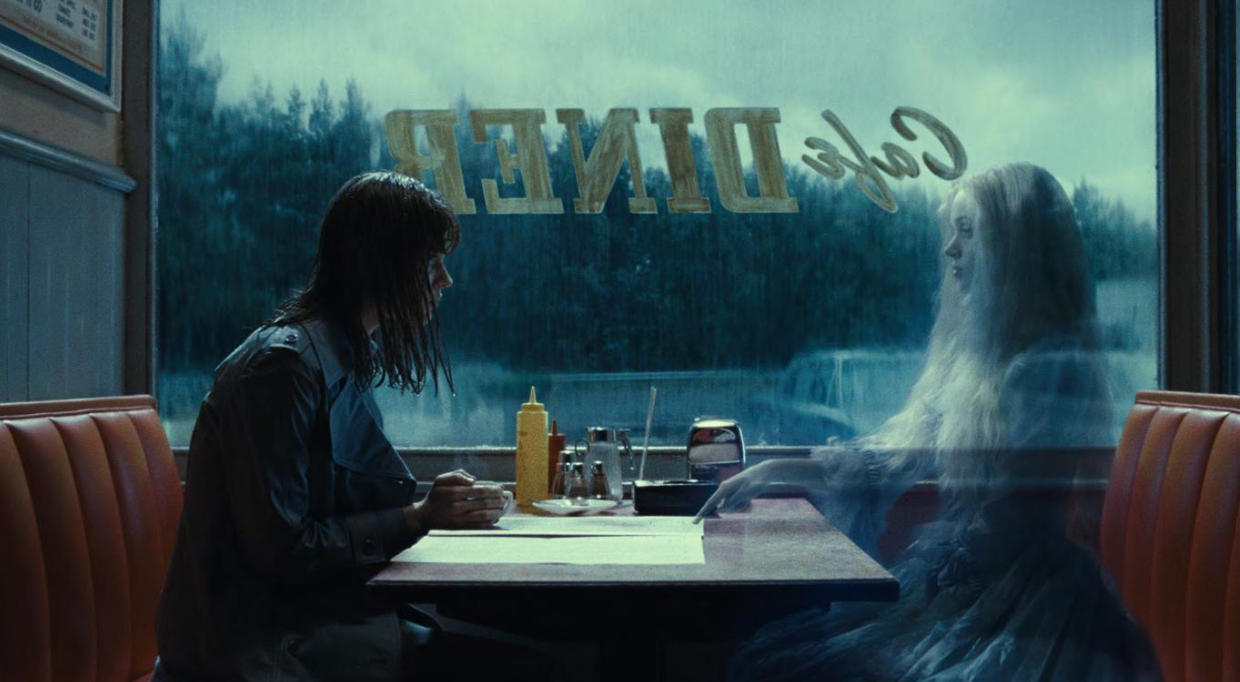
Sarah Collins had worked the night shift at the Desert Moon Diner for almost two years. The small restaurant sat beside an empty stretch of Route 66 in Arizona. During the day, tourists stopped for coffee and breakfast. At night, the parking lot was usually empty.
Sarah preferred the quiet. She could clean the counters, listen to the radio, and finish her shift without much trouble.
Until the man in Booth 6 appeared.
He arrived every night at exactly 2:00 AM.
He was around fifty years old, wore a dark brown jacket, and always ordered a black coffee. He never asked for food. He never used his phone. Most strangely, he never blinked.
At first, Sarah assumed he was simply an unusual customer.
But after the fourth night, she began feeling uncomfortable.
The man never looked away from her.
Even when she walked into the kitchen, she could feel his eyes following her.
On the seventh night, Sarah finally approached his booth.
“Can I get you anything else?”
The man slowly raised his coffee cup.
“No, thank you.”
His voice sounded dry and distant, almost like a recording played through an old speaker.
Sarah forced a smile.
“Will you be paying by cash or card?”
The man looked at her.
“I already paid.”
Sarah checked the register. There was no payment recorded.
Before she could respond, the restaurant lights flickered.
When they came back on, Booth 6 was empty.
The coffee cup remained on the table.
Sarah looked toward the entrance, but the front door had not opened. She checked the kitchen and the bathrooms. Nobody was there.
She decided to finish her shift and ask the owner about the strange customer in the morning.
While cleaning the counter, she noticed an old newspaper clipping pinned behind a shelf. It had probably been there for years.
The headline read:
**LOCAL MAN DISAPPEARS FROM ROUTE 66 — 1998.**
Beneath the headline was a photograph.
Sarah’s hands went cold.
It was the man from Booth 6.
The article identified him as Thomas Reed, a truck driver who had stopped at the Desert Moon Diner one night in October 1998. He had reportedly paid for a cup of coffee and then vanished without a trace.
Sarah checked the date again.
It was almost exactly twenty-eight years earlier.
She called the owner, Mr. Harris, who arrived shortly afterward. When Sarah showed him the photograph, he went silent.
“Where did you see him?” he asked.
“In Booth 6. He comes every night.”
Mr. Harris stared at her.
“Sarah, Booth 6 has been closed since the fire.”
She looked toward the booth.
A large wooden table covered the space. The booth had been removed years earlier after an electrical fire damaged that section of the diner.
Sarah stepped backward.
“Then where was he sitting?”
Mr. Harris didn’t answer.
The next night, Sarah refused to work alone. Her friend Rachel agreed to stay with her until closing.
At 2:00 AM, the entrance bell rang.
A cold breeze moved through the diner.
The man in the brown jacket walked inside.
He went straight toward the wooden table where Booth 6 used to be.
Rachel saw him too.
She grabbed Sarah’s arm.
“That’s impossible,” she whispered.
The man sat down.
He looked directly at Sarah.
Then he smiled.
Sarah ran toward the kitchen, pulling Rachel with her.
From the other side of the door, they heard a coffee cup being placed on a table.
Then a quiet voice spoke.
“You took your time.”
When they finally gathered the courage to return, the diner was empty.
On the counter sat a fresh cup of black coffee.
Beside it was a small paper receipt.
The date printed on it was October 14, 1998.
The customer name was Sarah Collins.
And beneath it, in faded ink, were three words:
**TABLE FOR TWO.**
Sarah quit the following morning.
The Desert Moon Diner closed a few months later.
Locals say the old building is still empty, but on rainy nights, a single neon light sometimes flickers above the entrance.
And if anyone looks through the window at exactly 2:00 AM, they might see a man sitting alone, staring at the door.
Waiting for his waitress.
**Some customers leave a tip. Others leave a warning. And some never leave at all.**